HONDURAS GENERAL INFORMATION


COUNTRY

Honduras (Spanish: República de Honduras, Spanish pronunciation: [republika de onduras]) is a democratic republic in Central America. It was formerly known as Spanish Honduras to differentiate it from British Honduras (now Belize).

    Flag
  Coat of arms


GEOGRAPHIC LOCATION

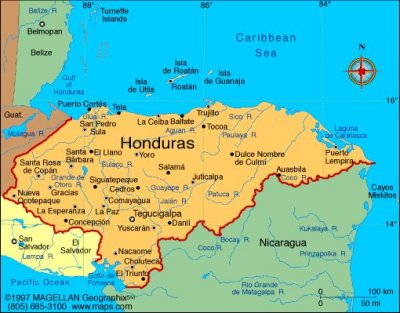
The country is bordered to the west by Guatemala, to the southwest by El Salvador, to the southeast by Nicaragua, to the south by the Pacific Ocean at the Gulf of Fonseca, and to the north by the Gulf of Honduras, a large inlet of the Caribbean Sea.


CAPITAL

Tegucigalpa


TIME ZONE

CST (UTC-6)


Internet TLD:

.hn


CALLING CALL

+504


AREA

112,492 km2


POPULATION

7.1 million
Ethnic Groups 90% Mestizos
7% Amerindian
2% Black
1% White


OFFICIAL LANGUAGE

Spanish (The main language is Spanish spoken by a 93.6 percent as first language. And as first and second language is spoken by 95 percent. The other languages that are minorities and are spoken by less than 4 percent, are Amerindian languages, and in the islands next to the coast English (spoken by less than a 0.3 percent).)

HONDURAN CURRENCY

Lempira

USA EXCHANGE RATE

Lps.19.02 = US $ 1.00
Lps.24.67 = Euro 1.00

GDP at current prices

8,507 millions of lempiras
(Estimated by Central Bank of Honduras) www.bch.hn


PRESIDENT

Porfirio Lobo Sosa


GOVERNMENT

Democratic Republic
Honduras has three Branches:
Executive, Legislative and Judicial

Executive
www.gob.hn

Cabinet: Cabinet appointed by the President
Elections: The President is elected by popular vote for a four-year term. http://www.tse.hn


H.E. Mr. Porfirio Lobo Sosa
President of the Republic of Honduras

Ministry of Foreign Affairs www.sre.hn

H.E. Mr. Mario Canahuatti
Minister for Foreign Affairs


Legislative
www.congreso.gob.hn

Unicameral National Congress (128 seats; whose members are elected proportionally by departments to serve four-year terms). Last election was held 21 December 2009. The president of the board of the National Congress is elected by a period of 4 years, the others members by 2 years.

Congress Committees www.congreso.gob.hn

Judicial
www.poderjudicial.gob.hn

Supreme Court of Justice: 15 judges are elected for seven-year terms by the National Congress

Supreme Court of Justice
Palace of Justice,
Governmental Civic Center,
next to the Secretary of Foreign Affairs
Tegucigalpa, M.D.C, Honduras
Telephone: (504) 269-3000
Fax: (504) 269-3069
Email: cedij@poderjudicial.gob.hn

ADMINISTRATIVE DIVISIONS

Honduras is divided into 18 departments: 1. Atlántida, 2. Choluteca, 3. Colon, 4. Comayagua, 5. Copan, 6. Cortes, 7. El Paraíso, 8. Francisco Morazán, 9. Gracias a Dios, 10. Intibuca, 11. Islas de la Bahía, 12. La Paz, 13. Lempira, 14. Ocotepeque, 15. Olancho, 16. Santa Bárbara, 17. Valle, 18. Yoro. The capital city is Tegucigalpa Central District of the department of Francisco Morazán.


Local Authorities
The Municipal Governments are elected directly by the local people through direct general elections, which are held every four years, together with the presidential elections. The local authorities are constituted by a Board with representatives of all political parties and the Mayor presiding the Board. Local Authorities of the Country get a subsidy from the Central Government equivalent to 5% of the Central Government budget and they are administrative and politically autonomous. The whole country has 298 municipalities, including the Capital of the Honduras.


SOCIAL AND ECONOMICAL SECTORS


EDUCATION

The public education system includes three cycles (primary, middle and superior) in the official language, which is Spanish. In the main cities there are duly certified and accredited bilingual schools (Spanish-English, Spanish-French); the graduates from these schools are accepted in the best world universities.

HEALTH

Extensive and large availability of private and public Hospitals and Clinics.

CULTURAL ACTIVITIES AND TOURISTIC ATTRACTIONS

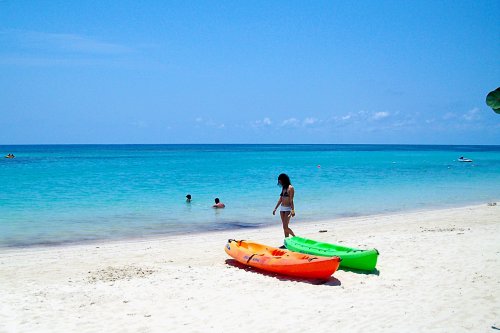
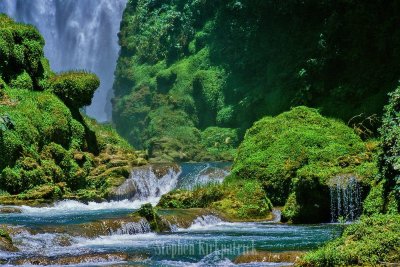
There is a diversity of tourism attractions like archeology, live cultures, nature (natural reserves for ecotourism). Honduras has also marvelous beaches in the Atlantic and/or Caribbean Seas coasts and in the Pacific. In the Bay Islands, in the Caribbean coast, there is the second best and most important World Coral Reef.

INFRASTRUCTURE

 
  A. AIRPORTS


Honduras has four (4) international airports in the cities of San Pedro Sula, Tegucigalpa, La Ceiba and Roatán (Bay Islands). The most important international airport is the one named Ramón Villeda Morales in the commercial industrial city of San Pedro Sula (SPS); the daily growing of activities in the SPS airport is linked to the assembly industries, known or referred to as “maquilas”, which operate mostly cargo planes, and also linked to the passengers tourist traffic. The second most important international airport is the one in the capital of the country, Tegucigalpa (TGU), named Toncontin Airport, the third is the one named Golosón International Airport, located in the Atlantic Port of La Ceiba (LCE), and the fourth is the International Airport Juan Manuel Gálvez, located in Roatan Bay Island (RTB).


Geographic Location of Airports and Sea Ports

  B. SEA PORTS


Honduras has ports in its Atlantic and Pacific coasts. The most important Port is Puerto Cortés; this port modern installations and equipments manage more than 50% of the imports and exports of the country and is certified in accordance with the standards of the International Maritime Organization (IMO). The USA Port Guard.

  C. ROAD NETWORKS
AND RAILROAD SYSTEM


The Honduran primary, secondary and rural road networks add up 13,603 kilometers and are responsibility of the Secretary of Public Works, Transportation and Housing (SOPTRAVI); about 20% of these roads are sound paved roads. There are other 12,000 kilometers of roads, some paved, other gravel, earth or feeder roads, that are administered by Municipalities, private companies, and public and private corporations or institutions such as HONDURAN CORPORATION FOR FORESTRY DEVELOPMENT (COHDEFOR), HONDURAN COFFEE INSTITUTE (IHCAFE), AND HONDURAN COFFEE FUND, among others.
Honduras was the first Central American country in signing a Railroad Construction Treatment, that happened in year 1853, during the Government of General José Trinidad Cabañas. Nonetheless, the country only counts with one railroad system with three (3) lines; this system is located in the north coast of Honduras and is used, specially, for the transport from and to and among the banana plantations of that zone. There is not a railroad line or railway route between the North Coast of Honduras and its Capital or other Central American Capital (All the Central American Capitals are connected by road and air transportation).

  D. TELE-COMMUNICATIONS


A trustworthy or reliable system of international direct dialing, mobile and satellite telephone service, internet service, broad band, dedicated lines, and high speed cordless communications.

  E. ELECTRIC ENERGY
110/230/460 Volts/60 HZ. Availability of electric energy and private thermal generation